
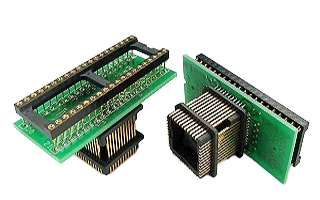
PA40-44-P64-DP, PIC16C64, 40-pin DIP TO 44-pin-PLCC
PA40-44-P64-DP-PP – 40-Pin DIP Socket to 44-Pin PLCC Emulator Adapter (Microchip PIC16C64 / 65 / 74 Family)
Overview
PA40-44-P64-DP-PP is a PLCC emulator adapter designed for Microchip PIC16C64, PIC16C64A, PIC16C65, PIC16C65A, PIC16C74, and PIC16C74A devices. As a result, engineers can evaluate 40-pin DIP PIC devices using systems that require a 44-pin PLCC emulator interface.
On the top side, the adapter provides a 40-pin DIP socket on 0.100″ (2.54 mm) pitch. Therefore, it accepts DIP-packaged PIC16C64/65/74-family devices and compatible parts used in development and validation workflows.
On the bottom side, the adapter presents a 44-pin PLCC plug. Consequently, it inserts directly into PLCC emulator sockets without additional cabling.
This adapter uses device-specific wiring rather than full 1:1 pin mapping. Instead, it aligns PIC port, oscillator, power, and PSP signals to the PLCC footprint. The Adapter Wiring table lists the exact connections.
Technical Specifications
- Part Number: PA40-44-P64-DP-PP
- Adapter Type: PLCC Emulator Adapter
- Top Interface: DIP-40 socket, 0.100″ (2.54 mm) pitch
- Bottom Interface: PLCC-44 plug
- Wiring Configuration: Device-specific wiring for PIC16C64/65/74 family (see Adapter Wiring)
- Device Support: Microchip PIC16C64, 64A, 65, 65A, 74, 74A & compatible devices
- Pitch: DIP side 0.100″ (2.54 mm); PLCC side 0.050″ (1.27 mm)
- JEDEC Reference: PLCC-44, MS-018
- Mount Interface: PLCC-44 plug insertion
- Typical Applications: Microcontroller emulation, firmware development, lab validation
- Compatibility: PLCC-44 emulator sockets supporting PIC16C64/65/74 workflows
Adapter Wiring
The following chart shows the connections from the DIP device to the adapter’s PLCC plug. The wiring is presented in a four-column format for quick verification.
The left half maps Device pins and signals to PLCC Plug pins. In parallel, the right half maps PLCC Plug pins back to their associated Device pins and signals.
| Device | Signal | Plug | Plug | Signal | Device |
|---|---|---|---|---|---|
| – | NC | 1 | 44 | RB7 | 40 |
| 1 | MCLR/Vpp | 2 | 43 | RB6 | 39 |
| 2 | RA0 | 3 | 42 | RB5 | 38 |
| 3 | RA1 | 4 | 41 | RB4 | 37 |
| 4 | RA2 | 5 | 40 | – | – |
| 5 | RA3 | 6 | 39 | RB3 | 36 |
| 6 | RA4/T0CKI | 7 | 38 | RB2 | 35 |
| 7 | RA5/SS | 8 | 37 | RB1 | 34 |
| 8 | RE0/RD | 9 | 36 | RB0/INT | 33 |
| 9 | RE1/WR | 10 | 35 | VDD | 32 |
| 10 | RE2/CS | 11 | 34 | VSS | 31 |
| 11 | VDD | 12 | 33 | RD7/PSP7 | 30 |
| 12 | VSS | 13 | 32 | RD6/PSP6 | 29 |
| 13 | OSC1/CLKIN | 14 | 31 | RD5/PSP5 | 28 |
| 14 | OSC2/CLKO | 15 | 30 | RD4/PSP4 | 27 |
| 15 | RC0/T1CKI | 16 | 29 | RC7 | 26 |
| 16 | RC1/T1CKO | 17 | 28 | N/C | – |
| – | N/C | 18 | 27 | RC6 | 25 |
| 17 | RC2/CCP1 | 19 | 26 | RC5/SD0 | 24 |
| 18 | RC3/SCK/SCL | 20 | 25 | RC4/SD1 | 23 |
| 19 | RD0/PSP0 | 21 | 24 | RD3/PSP3 | 22 |
| 20 | RD1/PSP1 | 22 | 23 | RD2/PSP2 | 21 |
Key Features
- DIP-40 socket supports PIC16C64/65/74-family DIP devices
- PLCC-44 plug interfaces directly with emulator sockets
- Device-specific wiring aligns ports, oscillator, power, and PSP signals
- Suitable for repeated lab use in emulation and validation workflows
Applications
- PIC microcontroller emulation
- Firmware development and debugging
- Device programming and characterization
- Engineering validation and laboratory testing
Package Includes
- One PA40-44-P64-DP-PP DIP-40 socket to PLCC-44 emulator adapter
Compatibility Note
This adapter does not use 1:1 wiring. Instead, it implements PIC16C64/65/74-family pin mapping as shown in the Adapter Wiring table. Therefore, verify target and emulator requirements before use.
Why Choose This Adapter
PA40-44-P64-DP-PP provides documented wiring for PIC emulation in PLCC-based systems. Moreover, it reduces setup time during development.
Because the adapter uses controlled routing, it minimizes pinout mistakes. As a result, engineers can focus on firmware and test results.
Streamline Your Workflow
Use this adapter to integrate DIP-based PIC devices into PLCC emulator environments efficiently. Consequently, development and validation cycles move faster.
$125.00
Specifications:
Related Products
-

PA44-PZP
44-Pin PLCC clamshell socket adapter with 1:1 wiring to PLCC plug. Ideal for prototyping, debug, and test environments requiring secure and repeatable device access.
$250.00 Add to CartPA44-PZP
44-Pin PLCC clamshell socket adapter with 1:1 wiring to PLCC plug. Ideal for prototyping, debug, and test environments requiring secure and repeatable device access.
$250.00 -

PA44-PP
44-Pin PLCC prototyping adapter with auto-eject ZIF socket and 1:1 wiring to PLCC plug. Ideal for production test and development environments.
$200.00 Add to CartPA44-PP
44-Pin PLCC prototyping adapter with auto-eject ZIF socket and 1:1 wiring to PLCC plug. Ideal for production test and development environments.
$200.00 -
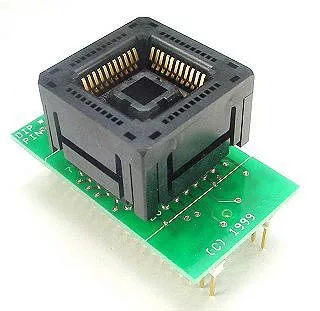
PA44-40-P64
PLCC Programming adapter for Microchip PIC16C64, 64A, 65, 65A, 74, 74A. Auto-eject PLCC socket. Products are built to order and usually ship within 1-2 business days.
$120.75 Add to CartPA44-40-P64
PLCC Programming adapter for Microchip PIC16C64, 64A, 65, 65A, 74, 74A. Auto-eject PLCC socket.
Products are built to order and usually ship within 1-2 business days.
$120.75 -
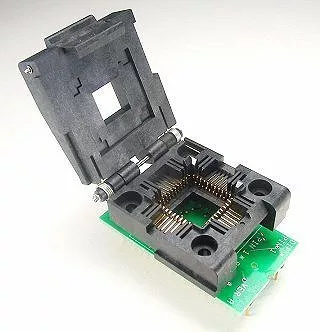
PA44-40-P64Z
PLCC Programming adapter for Microchip PIC16C64, 64A, 65, 65A, 74, 74A. Lidded ZIF PLCC socket. Products are built to order and usually ship within 1-2 business days.
$141.75 Add to CartPA44-40-P64Z
PLCC Programming adapter for Microchip PIC16C64, 64A, 65, 65A, 74, 74A. Lidded ZIF PLCC socket.
Products are built to order and usually ship within 1-2 business days.
$141.75