
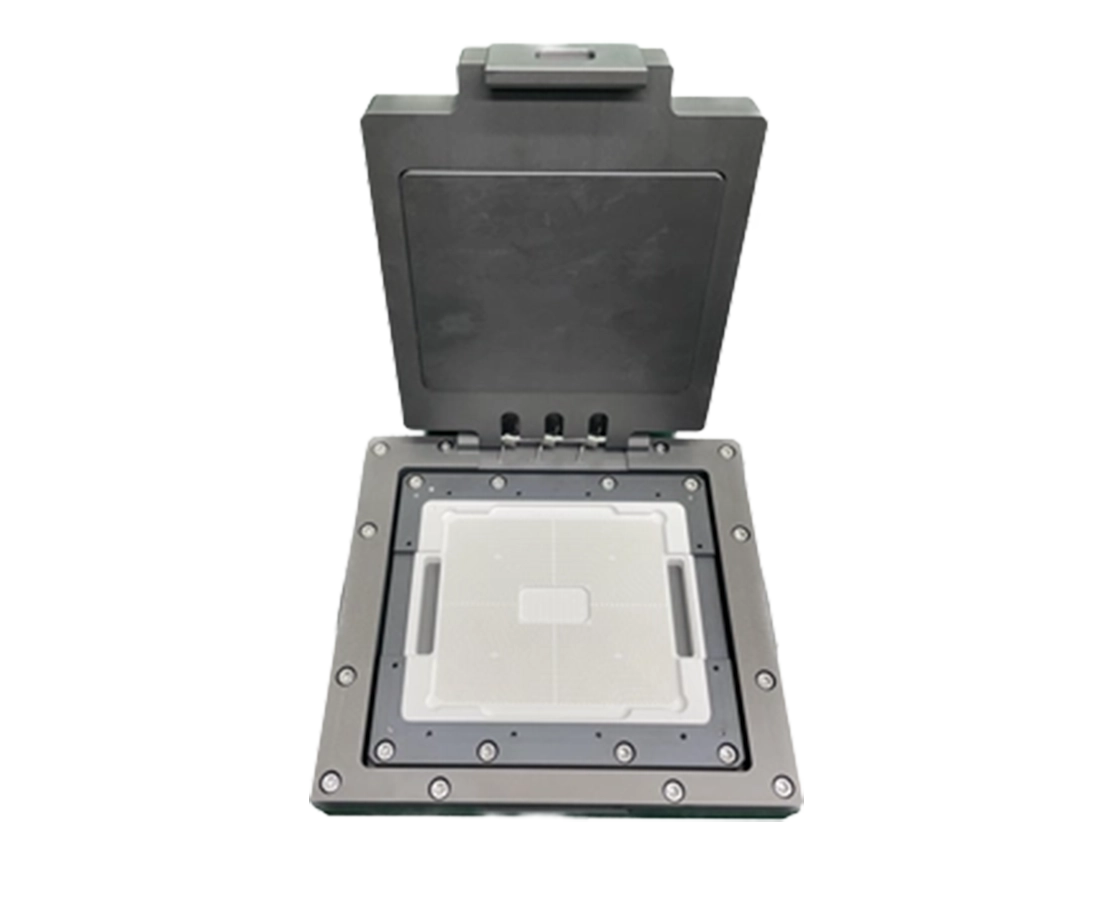
Spring Pin Test Sockets & IC Contactors
Spring Pin Test Socket Overview
Spring pin test sockets provide reliable, repeatable electrical contact between an integrated circuit and test system without soldering the device to the test board. Also referred to as IC contactors or pogo pin test sockets, these sockets use precision spring-loaded contacts for engineering validation, device characterization, production testing, burn-in, and environmental stress testing.
Adapt-Plus spring pin test sockets are built to order and configured to match the specific IC device and package. The socket base is selected according to the IC package size, while the contact interface is matched to the device pin count, pitch, and package type. Solutions are available for BGA, LGA, QFN, QFP, and other semiconductor packages.
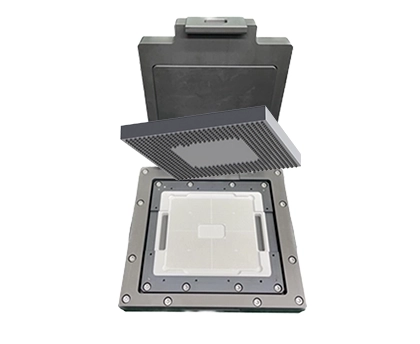
Standard Spring-Pin Test Socket Platforms
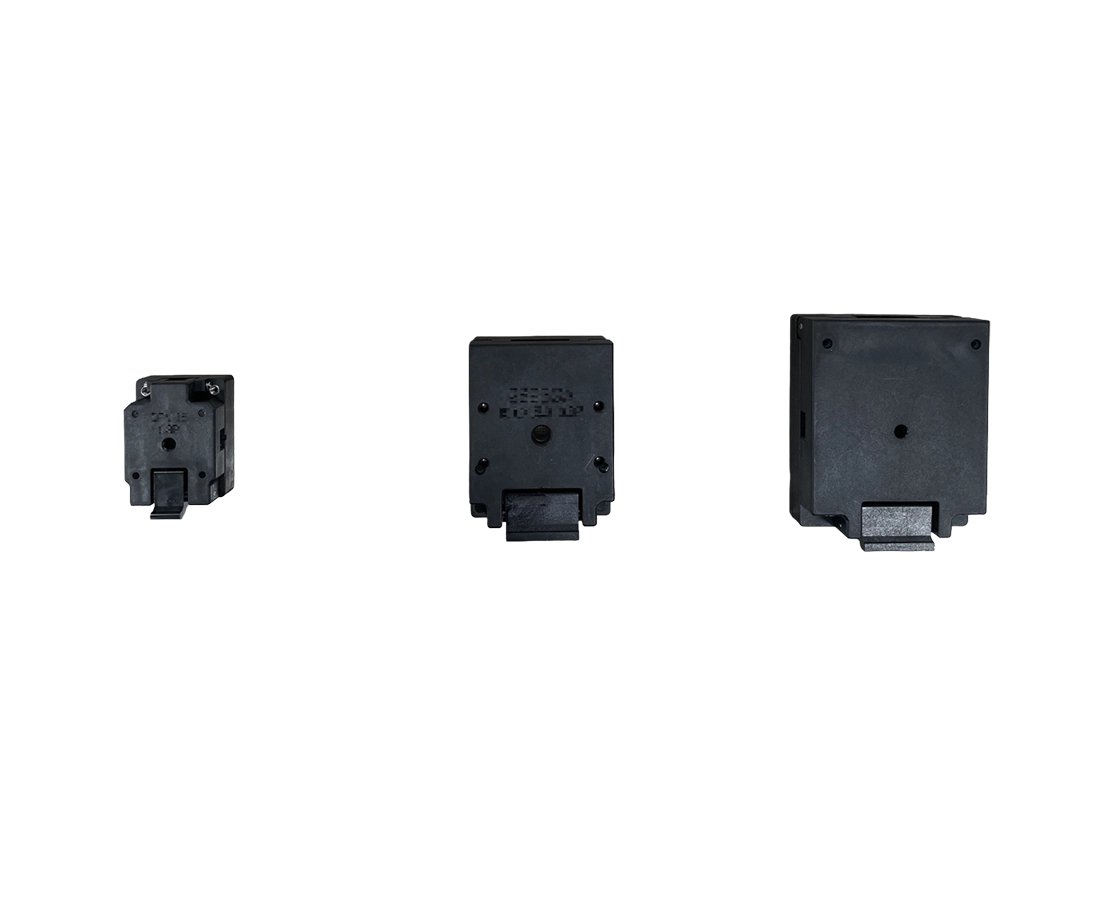
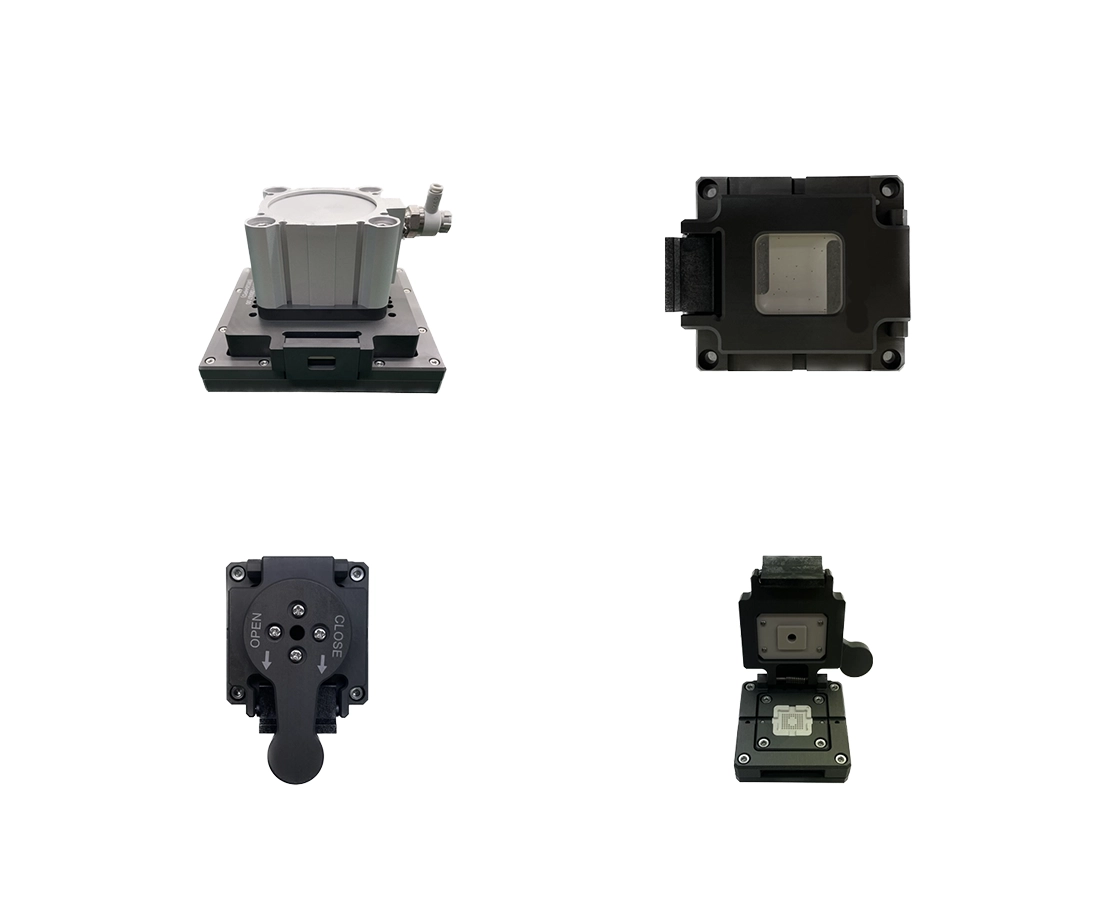
To reduce engineering lead time while maintaining design flexibility, most Adapt-Plus spring-pin test sockets are built on one of three standardized base platforms. These platforms accommodate the majority of semiconductor package sizes while allowing customization of the contact array, retention mechanism, actuation method, and mechanical interface to suit specific test requirements.
| Platform | Socket Body Size (mm) | Maximum Device Body (mm) | Typical Use | Customizable |
|---|---|---|---|---|
| Base 100 | 25 × 34 | Up to 14 × 14 | Compact devices and high-density layouts | Yes |
| Base 200 | 40 × 50 | Up to 24 × 24 | General-purpose platform for most applications | Yes |
| Base 300 | 50 × 61 | Up to 34 × 34 | Large devices and high-I/O applications | Yes |
If your device or fixture falls outside the capabilities of the standard platforms, custom spring-pin socket solutions are available.
Selecting the Right Spring-Pin Test Socket
Selecting the appropriate spring-pin test socket begins with understanding the mechanical, electrical, and environmental requirements of the device under test. While most applications can be accommodated using one of the standard Adapt-Plus socket platforms, each socket is configured specifically for the target device and test environment.
The following design parameters are typically reviewed during socket selection:
- Device body dimensions to determine the appropriate socket platform.
- Package type, pin count, and pitch to define the spring-pin contact layout.
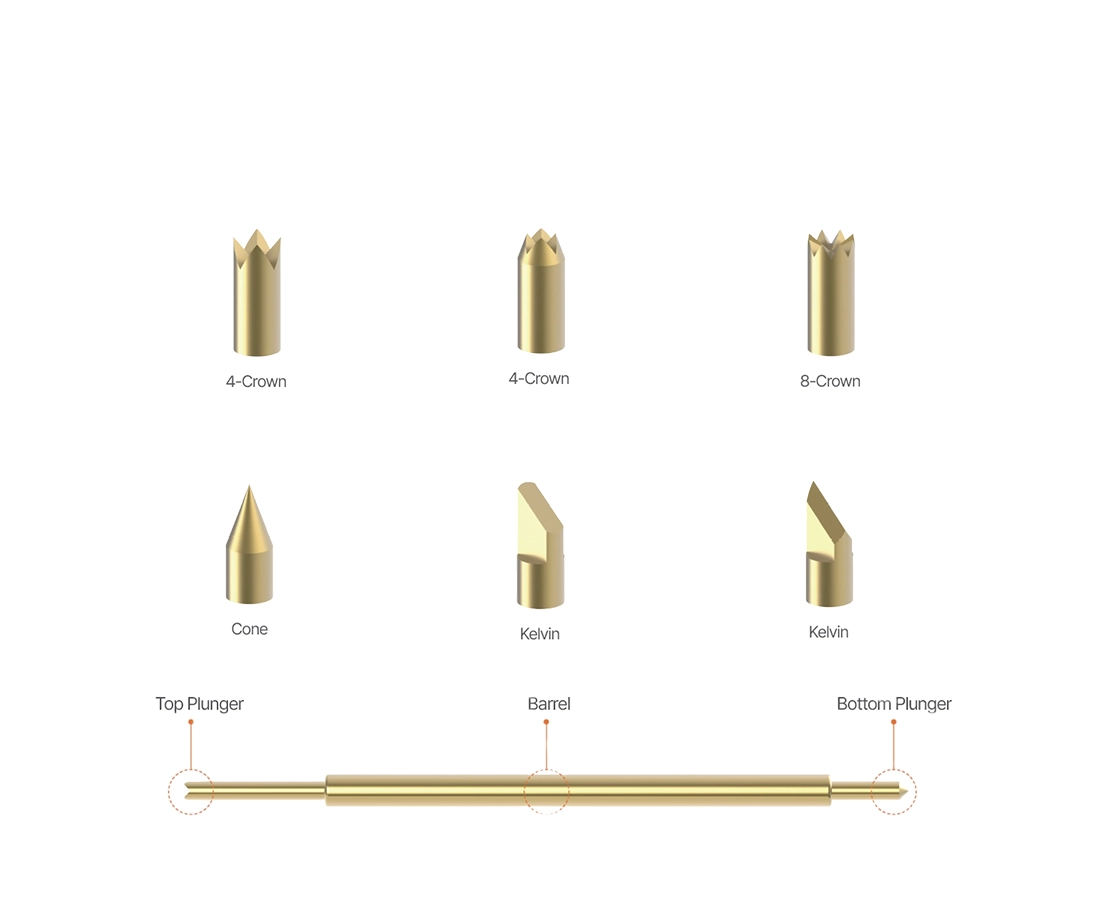
- Electrical requirements including current capacity, signal integrity, and Kelvin or high-frequency contact requirements.
- Operating environment such as engineering validation, ATE, burn-in, environmental testing, or production applications.
- Mechanical requirements including retention method, actuation style, fixture integration, and expected insertion cycle life.
If your application falls outside the capabilities of the standard platforms, Adapt-Plus can engineer a fully custom spring-pin test socket tailored to your device, fixture, and test requirements.
Supported IC Package Types
Adapt-Plus spring-pin test sockets support a wide range of semiconductor package families used in engineering validation, device characterization, production testing, and automated test equipment (ATE). Socket platforms are configured for the specific device rather than a single package family, allowing most surface-mount and array-based packages to be accommodated.
- BGA and LGA
- QFN and DFN
- QFP and TQFP
- SOIC, SOP, SSOP, and TSSOP
- CSP and WLCSP
- Custom and proprietary package formats
Platform selection is determined primarily by the device body dimensions and mechanical envelope. Contact layout, spring-pin selection, retention method, and socket features are then engineered to match the electrical and mechanical requirements of the device under test.
Typical Performance Specifications
Performance characteristics vary according to the selected spring-pin contact, device package, operating environment, and socket configuration. The specifications below represent typical capabilities of Adapt-Plus spring-pin test socket platforms. Custom configurations may be engineered to meet specific electrical, mechanical, or environmental requirements.
| Specification | Typical Value |
|---|---|
| Contact Material | Gold-plated copper alloy or beryllium copper, depending on contact type |
| Socket / Housing Material | PEI standard; PEEK or Torlon available for custom thermal, mechanical, or chemical requirements |
| Current Rating | Up to 1.0 A continuous per contact, depending on pin configuration |
| Mechanical Life | Application dependent |
| Contact Resistance | Contact dependent |
| Operating Temperature | Application dependent |
| Pitch Capability | Package and contact dependent |
| High-Frequency Contacts | Available |
| Kelvin (4-Wire) Contacts | Available |
| Non-Magnetic Contacts | Available |
| Pneumatic Actuation | Available |
| Thermal Management | Optional heat sinks, temperature sensors, and monitoring features |
Final specifications are determined during the engineering review process based on the device package, contact requirements, test environment, and application objectives.
Typical Performance Specifications
Performance characteristics vary according to the selected spring-pin
contact, device package, operating environment, and socket configuration.
The specifications below represent typical capabilities of Adapt-Plus
spring-pin test socket platforms.
| Specification | Typical Value |
|---|---|
| Contact Material | Gold-plated copper alloy or beryllium copper, depending on contact type |
| Socket / Housing Material | PEI standard; PEEK or Torlon available for custom thermal, mechanical, or chemical requirements |
| Current Rating | Up to 1.0 A continuous per contact, depending on pin configuration |
| Mechanical Life | Application dependent |
| Contact Resistance | Contact dependent |
| Operating Temperature | Application dependent |
| Pitch Capability | Package and contact dependent |
| High-Frequency Contacts | Available |
| Kelvin (4-Wire) Contacts | Available |
| Non-Magnetic Contacts | Available |
| Pneumatic Actuation | Available |
| Thermal Management | Optional heat sinks, temperature sensors, and monitoring features |
Final specifications are determined during the engineering review process
based on the device package, contact requirements, test environment, and
application objectives. Custom configurations may be developed for specific
electrical, mechanical, thermal, or environmental requirements.
Spring-Pin vs. BGA Locking Test Sockets
Spring-pin and BGA locking test sockets each provide reliable electrical connections for semiconductor testing, but they are designed for different mechanical and application requirements. Selecting the appropriate socket depends on the device package, test environment, insertion cycle requirements, and fixture design.
| Requirement | Spring-Pin Test Socket | BGA Locking Test Socket |
|---|---|---|
| High insertion cycle life | ✓ Excellent | Good |
| Coplanarity compliance | ✓ Excellent | Limited |
| Custom contact layouts | ✓ Fully configurable | Limited |
| Footprint compatibility | Custom interface | ✓ Matches device footprint |
| Typical applications | Engineering validation, characterization, ATE, burn-in | Production test, evaluation, prototype PCB testing |
Spring-pin test sockets are generally preferred when compliance, repeated device insertion, electrical performance, or application-specific customization are required. BGA locking sockets are often the better choice when a compact, footprint-compatible solution is needed for an existing PCB layout.
Why Adapt-Plus?
Adapt-Plus combines standardized socket platforms with application-specific engineering to deliver reliable spring-pin test socket solutions for engineering validation, production testing, and semiconductor characterization.
- Engineering-led design to optimize electrical, mechanical, and thermal performance for each application.
- Standardized socket platforms that reduce development time while supporting extensive customization.
- Configurable contact systems including standard, Kelvin, high-frequency, and application-specific spring-pin technologies.
- Custom mechanical solutions with multiple retention methods, actuation options, thermal features, and fixture interfaces.
- Reliable long-term performance engineered for repeatable electrical contact and high insertion cycle life.
Need a Custom Spring-Pin Test Socket?
Every Adapt-Plus spring-pin test socket is engineered for the specific device and test application. If your package, mechanical requirements, or test environment falls outside the capabilities of our standard configurations, our engineering team can develop a custom solution tailored to your application.
To begin the design process, provide your IC package drawing, pin count, package dimensions, operating environment, and any electrical or mechanical requirements. We’ll recommend the appropriate socket platform and develop a spring-pin test socket configuration optimized for your device and test objectives.
Frequently Asked Questions
What is a spring-pin (contactor) IC test socket?
A spring-pin (contactor) IC test socket uses precision spring-loaded contacts to create a temporary electrical connection between an integrated circuit and a test system without soldering. The compliant contacts accommodate package coplanarity variation while providing reliable electrical performance over repeated insertion cycles.
How do I select the correct spring-pin test socket?
Socket selection is based primarily on the device body dimensions, package type, pin count, pitch, electrical requirements, operating environment, and fixture constraints. Adapt-Plus uses standardized socket platforms that are then configured specifically for each application.
Which semiconductor package types are supported?
Spring-pin test sockets can be configured for a wide range of semiconductor packages, including BGA, LGA, QFN, DFN, QFP, TQFP, SOIC, SOP, SSOP, TSSOP, CSP, WLCSP, and many custom package formats. Platform selection is determined by the device body dimensions rather than the package family.
When should I choose a spring-pin socket instead of a locking socket?
Spring-pin test sockets are typically selected when high insertion cycle life, compliance for package coplanarity, custom contact layouts, or specialized electrical performance are required. Locking sockets are often preferred when footprint compatibility or a compact, drop-in solution is the primary requirement.
Do you sell spring pins (pogo pins) as standalone components?
No. Spring pins are selected and integrated as part of a complete spring-pin test socket design to ensure proper contact force, alignment, signal integrity, and long-term mechanical reliability.
Can spring-pin test sockets support high-frequency or RF applications?
Yes. High-frequency spring-pin contacts can be incorporated into custom socket designs for RF and high-speed digital applications. Contact selection depends on the required bandwidth, signal integrity, grounding strategy, and device characteristics.
Are Kelvin (4-wire) contacts available?
Yes. Kelvin spring-pin contacts are available for applications requiring precision resistance measurements, low-contact resistance, and other high-accuracy electrical testing.
What information is required to request a custom spring-pin test socket?
To evaluate a custom socket, we typically request the IC package drawing, package body dimensions, pin count and pitch, operating environment, electrical requirements, and any mechanical or thermal constraints. This information allows our engineering team to recommend the appropriate socket platform and develop a configuration tailored to your application.